Operations
Industrial spare parts procurement in Lithuania: how it really works, and what it quietly costs you
Get one offer
Industry is close to a third of Lithuania’s economy, and most of it runs in companies of between twenty and a few hundred people. Those companies have machines, the machines have parts, and somebody in each company spends a surprising share of their week buying those parts. Very few of them would call what they do “spare parts procurement”. They would call it “ordering stuff”, and they would tell you it takes far too long.
This article is an honest look at how that buying actually works in a mid sized Lithuanian plant, why it costs more than it appears to, and what the alternatives are. It is written for the people doing the buying: purchasing managers, maintenance managers, and the technical directors who end up with the folder of requests on their desk at six in the evening.
Who buys spare parts in a Lithuanian factory
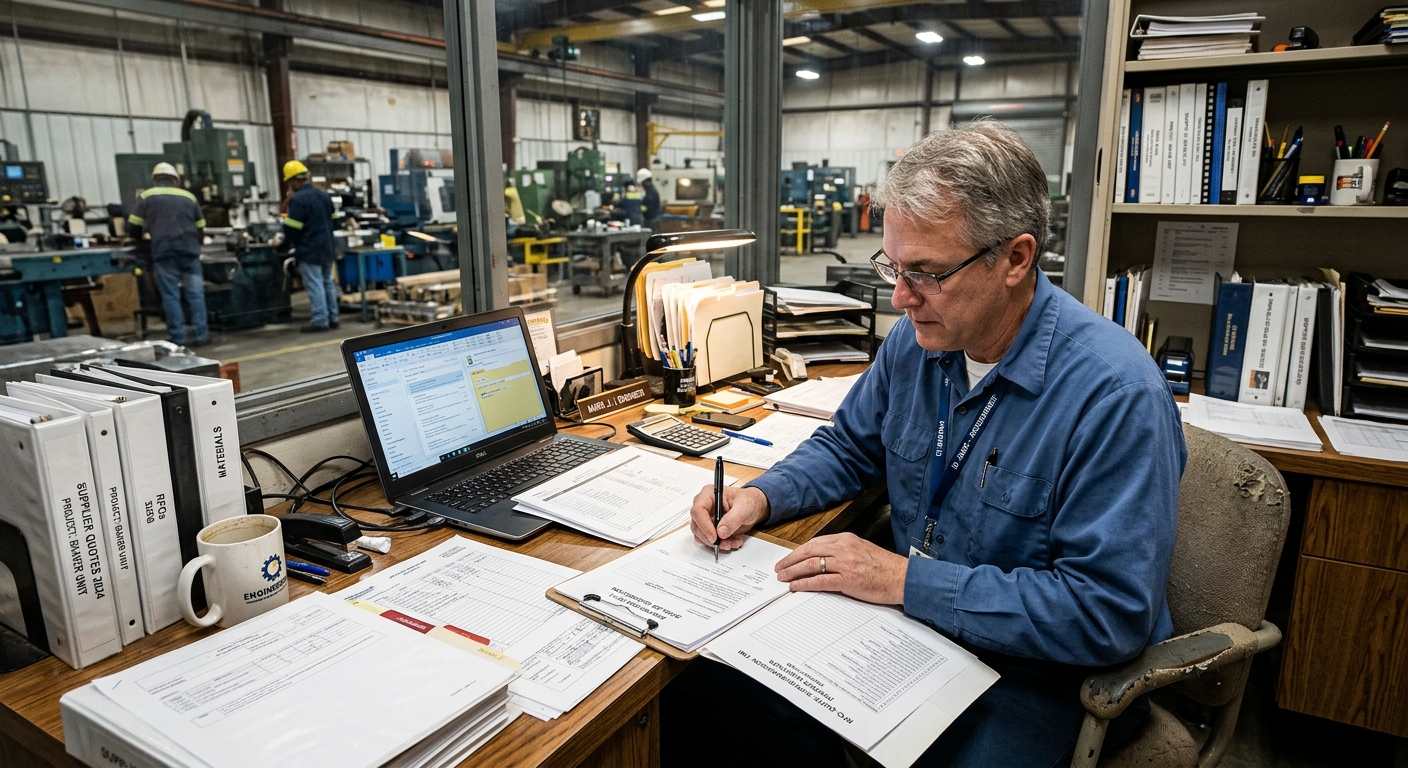
In a company of 80 to 150 people there is usually one purchasing manager, sometimes with a colleague. She handles everything from raw material to office supplies, and spare parts arrive as a stream of requests from maintenance by email, by message, on paper and in the corridor. In a company of 20 to 60 people there is often nobody. The technical director or the owner buys parts between everything else, usually after the phones stop.
Either way, the buying is done by someone whose main job is something else, with a spreadsheet, a phone and two or three suppliers they have known for years.
How the spare parts procurement process actually runs
A typical week looks like this. Maintenance produces a list of 20 to 40 lines across six or eight manufacturers: bearings, a contactor, some pneumatic fittings, a sensor, a drive belt, a few electronic components for a controller. Purchasing splits the list by likely supplier and sends three or four emails. Replies arrive over two to four days, in different formats, some with delivery included and some without, one of them quoting a different brand on a line without saying so. A comparison sheet is built by hand. An order is placed with two or three suppliers. Deliveries arrive over the following two weeks, and invoices over three. Each one is matched against a delivery note and booked.
For a planned purchase this is slow but survivable. For a breakdown it is a disaster, which is why maintenance teams learn to hoard. The stockroom fills with parts bought “just in case”, a share of which will never be used, and the cycle continues.
What the process costs, in numbers that are not from Silicon Valley
There is a lot of research on industrial procurement cost. Most of it comes from large American or German enterprises, with figures that mean nothing to a 60 person plant in Panevėžys. Two European studies are closer to home.
An analysis of tail spend at a German industrial company, published by Pedlar with Witzenmann in 2025, found more than 300 individual small orders a year at an average order value of around 260 euros. The process cost was roughly 140 euros per order. That is the cost of searching, requesting, comparing, ordering, receiving, booking and paying, before the price of the goods.
Manutan’s data on class C purchasing points the same way: these small, irregular items are around 85 percent of what a company buys by line count and account for about 75 percent of its suppliers, while representing a small fraction of spend by value.
Translate that to a Lithuanian plant with lower salaries and the process cost per order is lower, but not by the factor the parts value would suggest. The pattern holds: on a small spare parts order, the process often costs as much as the parts. Nobody sees it because it is spread across several people’s time and never appears as a line on any invoice.
Where to buy spare parts: Lithuania’s supplier landscape
Lithuanian buyers have a reasonable choice of suppliers, and the choice is part of the problem.
There are local distributors and stockists, often specialised in one product family: bearings and power transmission, electrical and automation components, pneumatics and hydraulics, machine tool parts. They know their products, they answer the phone, and they carry relationships that go back a decade. They rarely cover a mixed list.
There are the large international catalogue distributors serving Lithuania from Poland, Sweden or Germany. Their range is enormous and their prices are public, which makes them a useful reference. Their prices on some items also run well above the market, sometimes by a factor of two, and the buyer cannot know which items without checking line by line.
There are manufacturers’ own representatives for the major brands, good for the brand and no use for the rest of the list.
And there is a long tail of small specialists, surplus dealers and importers who hold exactly the obsolete parts nobody else has, and whom nobody can find.
The result is that a 30 line list realistically needs four or five suppliers, and nobody sells the process of dealing with four or five suppliers.
Why “just use the webshop” does not solve it
A common answer is to buy everything from one online catalogue. It removes the emailing, and for a single line it works. For a list it does not, for three reasons.
The first is coverage. No single catalogue stocks every brand a mixed maintenance list needs, so the odd lines go back to email. The second is price. Public catalogue prices on industrial items are often the highest in the market. A buyer paying them across a whole list is paying for convenience at a rate she would not accept if she saw it. The third is that a webshop only replaces the ordering step. The comparing, the receiving of several parcels, the several invoices, and the checking that the part number was right all remain.
What a better process looks like
The buying itself is not hard. What makes it expensive is that it is fragmented: many suppliers, many formats, many deliveries, many invoices, for one list. A better spare parts procurement process for a small plant consolidates it without taking away the buyer’s control.
In practice that means a few things. One list, checked for part number errors before it goes anywhere, because a wrong part number is the most common reason a wrong part arrives. One request that reaches every supplier who can actually cover a line, rather than the two the buyer happens to know. One reply, in one format, with landed prices so that shipping is not a surprise at the end. A rule the buyer sets in advance, cheapest, fastest, or by a date, so the comparison is done once instead of by hand each time. Visibility of which supplier is behind each line, so the buyer keeps the option to go direct where she already has a better price. And one invoice at the end, whatever the number of suppliers behind it.
That is a different shape of procurement platform from the enterprise tools built for companies with an approved vendor list and a procurement department. Those solve governance problems that a 60 person factory does not have. The problem here is simpler and more stubborn: too many small orders, each one handled by hand.
Where PartM8 sits in this picture
PartM8 is an industrial spare parts marketplace for exactly this: technical teams in Lithuania buying across a dozen manufacturers at once. You submit a parts list. Every part number is checked against a catalogue before it leaves, and you confirm any correction yourself. The list goes to vetted suppliers whose catalogue matches the lines, and one consolidated offer comes back within 24 hours, each line priced with delivery, with its lead time and its supplier named. You set the priority. You accept or walk away at no cost. Suppliers ship directly to you, and there is one invoice. PartM8 is the counterparty on the order, so there is no vendor account to open with each supplier and no credit check before you can see a price.
It is live for buyers in Lithuania today, with Latvia and Estonia next and Poland after that. It is not the right tool for a line that is down this afternoon; a 24 hour offer window is too slow for that. It is the right tool for the planned and restock buying that stops the afternoon emergencies from happening in the first place.
Frequently asked questions
What is spare parts procurement? Spare parts procurement is the process of identifying, requesting, comparing, ordering and receiving the replacement parts a company needs to keep its equipment running. In most small and mid sized manufacturers it is done by a purchasing manager or technical director alongside other work, using email and spreadsheets.
How much does a spare parts order really cost? European tail spend research puts the process cost of a small industrial order at around 140 euros against an average order value of about 260 euros. In Lithuania the figure is lower in absolute terms, but the process still often costs as much as the parts on small orders.
Where do Lithuanian factories buy spare parts? From a mix of local specialist distributors, international catalogue distributors serving the Baltics, manufacturers’ representatives, and a long tail of small specialists and surplus dealers. A mixed list typically needs four or five of them.
What is the difference between a procurement platform and a spare parts marketplace? A procurement platform typically manages approvals, vendor lists and spend control inside a larger company. A spare parts marketplace connects a buyer’s parts list with suppliers who can quote it. For a small plant without a procurement department, the second solves the actual daily problem.